Clubbing Is Dead. Long Live the Experience: How Immersive Nightlife Took Over a Generation
There's a specific kind of disappointment that comes with a bad night at a generic club. You know the one. Overpriced drinks in plastic cups, a DJ playing music you've heard a hundred times, fluorescent lighting that somehow makes everyone look tired, and the nagging feeling that you could be literally anywhere in the world and it would look exactly the same. For a long time, that was just... nightlife. You dealt with it.
Millennials and Gen Z are done dealing with it.
Something has fundamentally shifted in how younger generations think about a night out, and the numbers back it up. According to multiple hospitality industry reports, attendance at traditional nightclubs across the US has been declining for over a decade, while themed bars, immersive dining experiences, and story-driven entertainment venues are pulling record crowds. This isn't a blip. It's a full cultural realignment — and nowhere is that realignment more visible than in Tokyo, where places like Atlantis Ikebukuro have turned the very idea of a "night out" into something closer to stepping through a portal.
The Psychology Behind the Shift
So what actually changed? Part of it is generational psychology. Millennials came of age during economic instability, and Gen Z grew up watching the world get weird in real time. Both cohorts developed a heightened sensitivity to inauthenticity. They can smell a cash-grab experience from a mile away, and they respond by simply not showing up.
What they do respond to is meaning. Narrative. The feeling that a place was built with intention, that someone cared about every detail, that being there is genuinely different from being anywhere else.
Psychologists who study leisure behavior call this the "escapism premium" — the willingness to pay more, travel farther, and wait longer for an experience that genuinely transports you. Theme parks figured this out decades ago. The hospitality industry is only now catching up.
Immersive venues tap directly into this. When you walk into a space like Atlantis Ikebukuro — where the architecture evokes sunken ruins, where the cocktail menu reads like a mythology text, where the entire sensory environment has been calibrated to make you feel like you've descended into a lost civilization — your brain doesn't process it as "going to a bar." It processes it as going somewhere. That distinction is enormous.
The Instagram Factor (But Not in the Way You Think)
A lazy take on this trend would be to say it's all about social media. That younger people just want a cool backdrop for their photos and that's the whole story. That's not wrong, exactly, but it dramatically undersells what's actually happening.
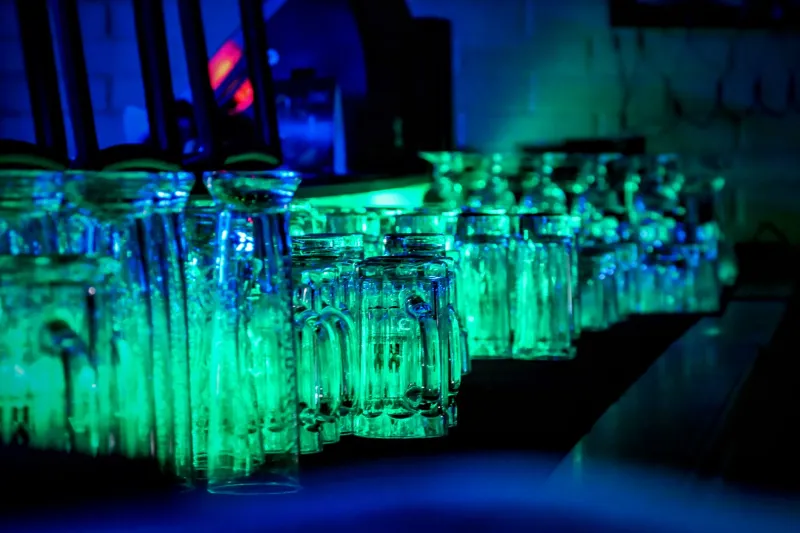
Yes, immersive venues photograph beautifully. Atlantis Ikebukuro's bioluminescent bar lighting and hand-sculpted coral installations look absolutely wild on a grid. But the reason those posts perform so well isn't just aesthetics — it's that they communicate story. When someone posts a photo from a truly immersive venue, they're not just showing off where they were. They're sharing a piece of a narrative. "I went somewhere that felt like another world" is a fundamentally more compelling social statement than "I went to a club."
That storytelling quality is what drives word-of-mouth in a way that traditional clubs simply can't replicate. American travelers who've made the trip to Ikebukuro don't come back talking about the music or the crowd — they come back talking about the feeling. That's the Atlantis Effect in action.
Why American Venues Are Playing Catch-Up
Here's an uncomfortable truth for the US hospitality industry: Tokyo has lapped us on this one. American nightlife innovation has largely stalled around the same formula — bigger sound system, better celebrity DJ, fancier bottle service. Meanwhile, venues like Atlantis Ikebukuro have been quietly building something that operates on a completely different level.
Part of this is cultural. Japan has a long tradition of crafting deeply intentional hospitality experiences — the concept of omotenashi, or wholehearted service, runs through everything from a ryokan stay to a neighborhood ramen shop. Applying that philosophy to nightlife produces something that American venues, which often prioritize volume and throughput, struggle to match.
There are signs that the US is starting to wake up. Immersive cocktail bars, escape-room-adjacent social clubs, and narrative-driven pop-ups have been gaining traction in cities like New York, LA, and Chicago. But they're still largely novelties — weekend attractions rather than fully realized alternate worlds. The gap between what those venues offer and what Atlantis Ikebukuro delivers remains significant.
What "Authentic" Actually Means in 2025
One word keeps coming up when you talk to younger travelers about what they're looking for in a night out: authenticity. It's a word that gets thrown around so much it risks losing meaning, but in this context it has a specific definition.
Authenticity doesn't mean rustic or unpolished. Atlantis Ikebukuro is meticulously designed — nothing about it is accidental. What makes it feel authentic is that every element of the experience serves a coherent vision. The mythology isn't a thin coat of paint over a standard club layout; it's structural. It shapes the drinks, the décor, the staff interactions, the music, the lighting. The story is the venue, not decoration on top of it.
For a generation that grew up with access to infinite content and developed finely tuned detectors for fakeness, that coherence registers immediately. It's the difference between a haunted house and a world you actually believe in, even briefly, even while knowing it's constructed.
The Night Out as Event
Maybe the simplest way to understand the shift is this: younger generations have stopped thinking of a night out as a category of activity and started thinking of it as an event. Something worth planning, worth traveling for, worth remembering.
That reframe changes everything about what a venue needs to deliver. It's not enough to have good music and decent drinks. You need to give people something they'll be talking about at brunch next Sunday — and honestly, something they'll still remember in five years.
Atlantis Ikebukuro was built for exactly that kind of night. The lost city doesn't just come alive after dark. It gives you a story to carry home with you. And in 2025, that's the most valuable thing a nightlife venue can offer.