When the Algorithm Lost to a Legend: How Atlantis Ikebukuro Is Forcing Silicon Valley to Rethink Everything It Thought It Knew About Experience
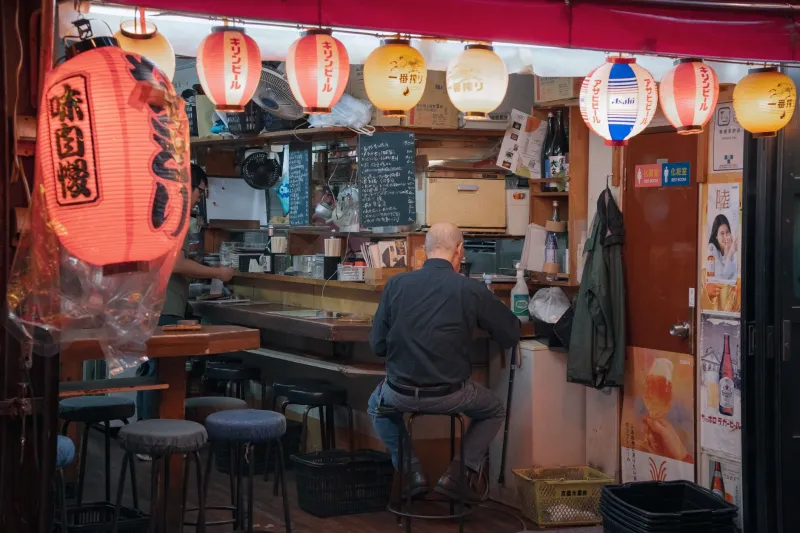
There's a certain kind of confidence that comes with building things in Silicon Valley. You instrument everything. You A/B test your way to answers. You trust the data over your gut, and you assume that if you can measure something precisely enough, you can optimize it into something people love. That framework has produced trillion-dollar companies. It has also, quietly, been getting humiliated by a bar in Ikebukuro themed around a sunken civilization.
Atlantis Ikebukuro wasn't designed in a growth lab. Nobody ran cohort analysis on its mythology-soaked cocktail menu. There was no retention funnel mapped before the trident wall sconces went up. And yet American travelers — the exact demographic that tech platforms have spent billions trying to understand and monetize — are flying to Tokyo specifically to spend a night there, then flying home and immediately planning their return. The experience economy crowd is paying attention, even if they're not totally sure what to do with what they're seeing.
What the Experience Economy Actually Promised
Back in 1998, economists B. Joseph Pine II and James Gilmore published a now-legendary piece in the Harvard Business Review arguing that experiences were the next frontier of economic value — that people would pay more for something they did than something they merely owned. Silicon Valley took that idea and ran with it, eventually producing everything from WeWork's "community" pitch to the gamification layer slapped onto every fitness app that came out between 2015 and 2020.
The underlying assumption was rational: if you could identify what components of an experience made people feel good, you could engineer those components deliberately, scale them efficiently, and build a business around the result. Emotion was essentially treated as a design variable — something to be dialed up or down based on user feedback loops.
What nobody fully accounted for was the difference between an experience that performs emotion and one that generates it from somewhere real. That gap is exactly where Atlantis Ikebukuro lives.
Narrative Does Something Data Can't
Walk into Atlantis Ikebukuro and you're not being handed a curated "moment." You're being dropped into a world with its own internal logic — a place where the mythology of a lost civilization isn't backdrop decoration but the actual organizing principle behind every design decision, every drink, every interaction with the staff. The story isn't a layer on top of the experience. It is the experience.
That distinction matters more than it might sound. When guests feel like they've entered a coherent world rather than a branded environment, something neurologically different happens. They stop being consumers evaluating a product and start being participants inside a narrative. Their guard comes down. Their sense of time warps. They spend more, stay longer, and remember the night with a vividness that a perfectly optimized cocktail lounge simply cannot replicate.
Venture capitalists who've toured immersive entertainment concepts across the US — escape rooms, dinner theaters, pop-up brand experiences — often describe them in terms of their mechanics: how the puzzles work, what the throughput is, how many SKUs are in the gift shop. Atlantis Ikebukuro resists that kind of breakdown because the thing that makes it work isn't a mechanic. It's a myth. And myths don't have a unit economics model.
The Optimization Trap
Here's the uncomfortable truth that a venue like Atlantis Ikebukuro surfaces for the tech world: optimization is often the enemy of wonder. When you A/B test your way to a menu, you get a menu that performs well on average. When you design an interior based on engagement heat maps, you get a space that holds people's attention efficiently. What you don't get is a space that makes someone feel like they've stumbled onto something ancient and irreplaceable.
American travelers are increasingly fluent in the language of optimization. They can smell a focus-grouped experience from across the room. They know when a "moment" has been engineered for their Instagram feed rather than for their actual enjoyment. And they are, in growing numbers, exhausted by it. The appeal of Atlantis Ikebukuro isn't just that it's beautiful or well-executed — it's that it feels unauthorized in some fundamental way, like it wasn't built to satisfy a committee's KPIs but to actually transport you somewhere.
That feeling of authenticity — even when the venue is clearly a constructed fiction — is the thing that data-driven design struggles hardest to manufacture. You can't A/B test your way to a myth. You have to commit to one.
What the Smart Money Is Starting to Notice
There are early signs that some corners of the investment world are recalibrating. Conversations happening at the intersection of hospitality, entertainment, and real estate are increasingly circling around the idea of "narrative infrastructure" — the notion that the story a space tells is as much a capital asset as the physical build-out. That's a long way from the experience economy's original promise of scalable emotional design.
What Atlantis Ikebukuro demonstrates is that depth beats breadth in this category. A venue that goes fully, almost recklessly, all-in on a single mythological identity will outperform a venue that tries to be many things to many people. That runs counter to every instinct Silicon Valley has about building for scale and broad addressable markets. But it aligns perfectly with what American travelers actually report wanting: something specific, something strange, something that couldn't exist anywhere else.
The Lesson Nobody Wanted to Learn
The most disruptive thing about a place like Atlantis Ikebukuro isn't its design or its cocktails or even its social media footprint. It's the implicit argument it makes against the dominant logic of the experience economy. It suggests that the best experiences aren't engineered — they're believed in. That the difference between a night you talk about for years and a night you forget by Tuesday isn't a matter of optimizing the right variables. It's a matter of building something with genuine conviction and letting the story do the work that no algorithm ever could.
Silicon Valley built tools to understand what people want. Atlantis Ikebukuro built a world that reminded people they wanted something they didn't even have a word for. The fact that a mythological bar in Tokyo is making tech investors uncomfortable might be the most interesting thing happening in experiential entertainment right now.
And if you want to understand why, you're probably going to have to book a flight.