Sunken Stories in a Glass: How Tokyo's Bars Are Pouring Atlantis Into Every Sip
There's a moment, somewhere between your second cocktail and the soft blue glow rippling across the ceiling, when you stop thinking about the subway ride home and start wondering whether Plato was onto something. That's the magic of Ikebukuro's Atlantis-inspired bar scene — and it's not an accident.
Tokyo has long been a city that treats nightlife as performance art. But in recent years, a cluster of venues in Ikebukuro has taken that instinct and submerged it entirely in myth. The result is something genuinely unlike anything you'll find in New York, Los Angeles, or anywhere else on the planet.
The Myth That Keeps Giving
Atlantis, as a concept, has survived for over two thousand years on the strength of exactly zero confirmed evidence. Plato wrote about it in 360 BCE as a cautionary tale about hubris and civilization's fragility. And yet, the story never really died. It's been reimagined by everyone from Jules Verne to Disney, and now — perhaps most deliciously — by Japanese bartenders who treat mythology the way they treat everything else: with obsessive precision and a deep respect for craft.
The appeal isn't hard to understand. Atlantis represents something universal: a world that was magnificent, mysterious, and lost. For a bar experience, that's basically a perfect emotional brief. You want people to feel like they've discovered something rare, something just slightly out of reach. Pour that feeling into a coupe glass and you've got a concept worth building a venue around.
Underwater Aesthetics, Overground Execution
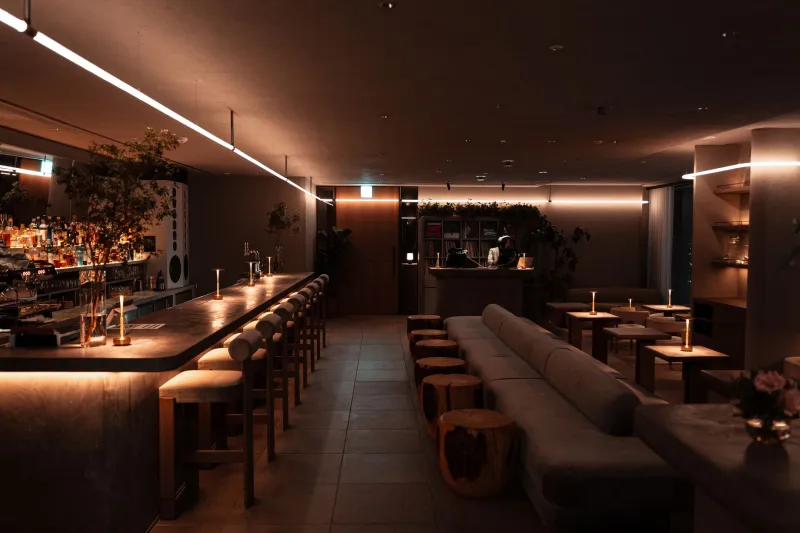
Walk into one of Ikebukuro's Atlantis-themed bars and the first thing that hits you isn't the menu — it's the room itself. Japanese interior designers have an almost eerie ability to transform a relatively compact urban space into something that feels boundless. Think bioluminescent lighting rigs that shift from deep violet to teal as the night progresses. Think walls textured to suggest ancient stone columns half-swallowed by coral. Think bar tops embedded with illuminated maps of a continent that technically doesn't exist.
The aesthetic borrows heavily from oceanic imagery — deep-sea blues, kelp greens, the amber glow of something ancient and waterlogged — but it never tips into cheesy theme-park territory. That's the Japanese hospitality difference. Where an American venue might lean into spectacle for its own sake, the best Ikebukuro bars treat the atmosphere as a stage that serves the drink, not the other way around.
The Menu as Mythology
This is where things get genuinely interesting for cocktail enthusiasts. Signature menus at Atlantis-inspired venues in Ikebukuro read less like drink lists and more like chapters from a lost history book. You'll find cocktails named after Atlantean concepts — drinks built around the idea of depth, discovery, submersion, and memory.
Ingredients are chosen with the same narrative intentionality. Japanese shōchū and sake often anchor the spirit selections, but they're layered with imported botanicals, sea salt tinctures, activated charcoal for that deep-ocean darkness, and housemade syrups that evoke things like ancient amber or crushed volcanic mineral. One popular format involves a cocktail that changes color as you drink it — starting murky and dark at the surface, then brightening as you work your way down. The metaphor practically writes itself.
Non-alcoholic options are equally considered. Ikebukuro's bar culture has embraced the mocktail movement with more seriousness than most American venues have managed, and the mythological framing gives zero-proof drinks the same sense of narrative weight. A "Poseidon's Reserve" with zero alcohol still gets the same theatrical presentation: mist, layered color, and a garnish that looks like it was foraged from the sea floor.
Japanese Hospitality Meets Western Mythology
What makes this particular fusion so compelling is the cultural tension at its heart. Omotenashi — the Japanese concept of selfless, anticipatory hospitality — doesn't naturally map onto Western mythology's drama and excess. Atlantis, after all, is a story about a civilization that got too big for its own good. And yet, the pairing works.
Japanese bartenders tend to approach Atlantis not as a cautionary tale but as an invitation to imagine perfection. The lost city, in this reading, wasn't destroyed because it was flawed — it was simply waiting to be rediscovered. That's a much more hospitable interpretation, and it shows in how guests are treated. You're not a tourist consuming a theme. You're an explorer who has finally found what they were looking for.
For American visitors especially, this reframing lands differently than it might for a local crowd. We grew up with Atlantis as pop culture shorthand — the cartoon, the aquarium exhibit, the Vegas resort. Encountering it treated with genuine reverence and craft bartending skill is a little disorienting in the best possible way.
The Instagram Factor (And Why It's Actually Earned)
Let's be honest: part of what drives people to these bars is the visual payoff. A color-changing cocktail in a hand-blown glass shaped like a deep-sea creature, set against a backdrop of glowing ruins? That's going to end up on someone's feed. But the best Ikebukuro venues have figured out something important — the photo opportunity should be a byproduct of genuine quality, not the point of the exercise.
When the drink is actually delicious, when the room genuinely transports you, when the bartender takes three minutes to explain the story behind what you're holding — the photo you take means something different. It's not just content. It's a record of a real experience.
That's what keeps international visitors coming back, and what keeps Atlantis Ikebukuro on the radar for travelers who've already done the obvious Tokyo stops. The myth is the hook. The craft is what makes you stay.
Finding Your Own Lost City
If you're planning a Tokyo trip and nightlife is anywhere on your list, Ikebukuro's Atlantis-inspired bar scene deserves serious consideration. It's not the cheapest night out — quality cocktail culture in Tokyo rarely is — but the value proposition extends well beyond what's in the glass. You're paying for a complete sensory experience, one that's been thought through from the music curation to the way the ice is cut.
The legend of Atlantis has endured because it speaks to something we all feel: the suspicion that somewhere out there, there's a more extraordinary version of the world, just waiting to be found. In Ikebukuro, at least, you don't have to look very hard.